Posts

Showing posts with the label jiban jyoti dash

Paleontologists find fossil relative of Ginkgo biloba

Image
The fossils, from the species  Umaltolepis mongoliensis,  date back to the early Cretaceous Period (some 100-125 million years ago). Scientists discovered the fossils in ancient peat deposits at the Tevshiin Govi mine in the steppes of central Mongolia. Results of the research, supported by the National Science Foundation (NSF), are published in this week's issue of the journal  Proceedings of the National Academy of Sciences (PNAS). "The stems and leaves are similar to the ginkgo tree, but the seeds, and especially the structures they are born in, are unlike any other known plant, living or extinct," says scientist Patrick Herendeen of the Chicago Botanic Garden, co-author of the  PNAS  paper. "Finding something like this does not happen very often." Scientists had previously uncovered fossils of  U. mongoliensis,  but those were in poor condition, making them difficult to study. Hundreds of better-preserved new fossils show that features of the ste...

Equation helps to explain plantgrowth

Image
A cross section one micrometer thick of a California scrub oak (Quercus agrifolia) leaf. Plantbiologists use images like these to 'lift the hood' of the leaf to identify and measure cells and tissues, labeled in this image. The waxy coatingon the outside of the leaf is called the upper and lower cuticle (UC and LC, respectively); beneath the cuticle is the upper and lower epidermis, or leaf skin (UE and LE). Photosynthesis occurs in the central spongy and palisade mesophyll cells(SP and PA, respectively). Veins (V) for water and sugartransport are wrapped in a ring of cells known as the bundle sheath (BS) which extend to the epidermis to the epidermis (bundle sheathextensions; BSE). Cells measured in the cross-section can be mathematically modelled in 3-D as cylinders, capsules or spheres. It is rare in biology that a single trait can answer questions spanning severalfields of research. One such trait is plant biology's"leaf mass per area," a simple measurement ...

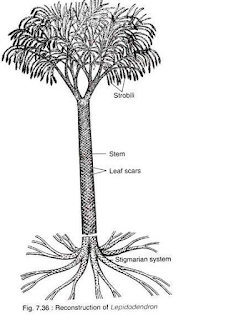
LEPIDODENDRON

Image
Lepidodendron: Habit and Habitat of Lepidodendron: A new groups of arborescent lycopods, popularly known as Lepidodendrales, had evolved from the Middle Devonian lycopods. These arborescent plants would grow to 164 ft (50 m) and form extensive coal measures swamp forest of the Northern Hemisphere Euramerican province during the Carboniferous period. Among these, Lepiclodendron was the most successful of all the arborescent members and is the best-investigated genus (Fig. 7.36). In early stage of development, an endosporic prothallus grew straight up and subsequently it expanded its diameter by secondary growth until its apical meristem divided. Thus, in the successive dichotomy, the size of the branches decreased until the growth finally ceased with terminal twig. So the plant had a determinate growth pattern. The Lepidodendron was a large tree (50-60 m tall) with a prominent trunk (up to 35 m height). The ultimate dichotomies formed the leaves. The branches and the foliage...

my first blog

Basically in +3 level or in graduation level biological students come across various fundamental topics  on biology.It's my first blog and I'm going to publish some posts on this blog about some biological topic. I will describe about the pteridophytes in my next blog and please stay connected with me.                                                                                                                                                    THANK YOU